

Conducting Your Annual Review of the Radiation Protection Program: Key Insights and Best Practices
Every radiation safety program should undergo a thorough annual review—not simply as a regulatory requirement, but as an opportunity for continuous improvement. The annual review ensures that your Radiation Protection Program (RPP) stays current, effective, and aligned with both regulatory expectations and the practical realities of day-to-day operations.
Why the Annual Review Matters
Regulations require that each RPP be reviewed at least once every year, but the purpose extends well beyond compliance. A meaningful review helps identify opportunities to strengthen program quality, address deficiencies, and adapt to evolving standards. Many organizations complete this review early in the new year, using data from the previous twelve months to guide updates and improvements.
Core Components to Include
A comprehensive annual review should evaluate all aspects of the radiation safety program, including both radioactive materials and machine-produced radiation such as X-rays and linear accelerators. Key areas to assess include:
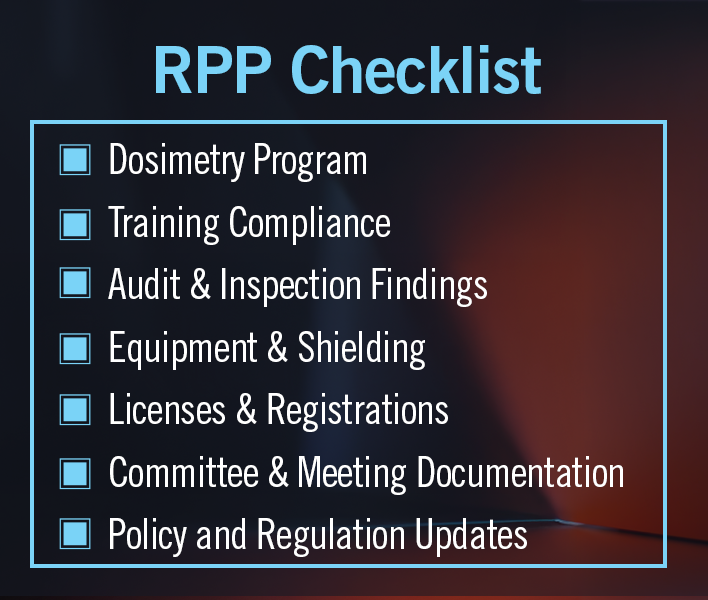 Dosimetry Program: Review participation, investigate unused or unreturned dosimeters, and evaluate overall quality.
- Training Compliance: Confirm that required training—initial and refresher—has been completed within the appropriate timeframes for all affected personnel, including ancillary departments such as nursing, environmental services, and security.
- Audit and Inspection Findings: Verify that quarterly audits (for example, in nuclear medicine or PET) are completed, deficiencies corrected, and corrective actions documented and effective.
- Equipment and Shielding: Review PPE inventories, lead apron inspection and disposal records, and shielding documentation.
- Licenses and Registrations: Ensure your radioactive materials license and X-ray registrations are accurate and current.
- Committee and Meeting Documentation: Confirm that radiation safety or equivalent committee meetings meet quorum and attendance requirements, and that meeting minutes are complete, accessible, and properly maintained.
- Policy and Regulation Updates: Identify and incorporate any new or revised regulations, standards, or internal policies that affect the program.
Once the review is complete, the report should be signed, dated, and presented to the appropriate leadership group (such as a Radiation Safety Committee, safety committee, or quality council) for acknowledgment and recordkeeping.
The Value of an Annual Letter to Management
Although not required by regulation, issuing an Annual Letter to Management is considered a best practice. This brief summary communicates that the review has been completed, outlines overall program status, and highlights any major improvements or corrective actions. The letter documents accountability and demonstrates proactive oversight of the RPP.
Common Pitfalls to Avoid
Experience shows that several recurring issues often arise during inspections and audits:
- Unsigned or improperly signed reports – missing or invalid signatures can render the review incomplete.
- Failure to update the RPP after inspections or findings.
- Training gaps following new equipment installations or procedural changes.
- Discrepancies between written policies and actual practices.
- Incomplete or outdated emergency procedures and drill documentation.
- Missed equipment performance evaluations that exceed the required inspection interval.
Aligning written policy with daily practice and maintaining all documentation—such as shielding plans, calibration records, and audit results—ensures readiness for inspection and strengthens compliance.
Building a Culture of Continuous Improvement
An effective annual review goes beyond verification—it’s a cornerstone of a culture of safety. Engaging frontline staff, documenting corrective actions, and regularly evaluating program performance promotes awareness, accountability, and continuous improvement. By treating the annual RPP review as an ongoing process rather than a yearly task, organizations can maintain both compliance and confidence in the strength of their radiation safety programs. If you need help creating, reviewing, or updating your RPP, we’re here to help! Contact us to discuss your needs.