
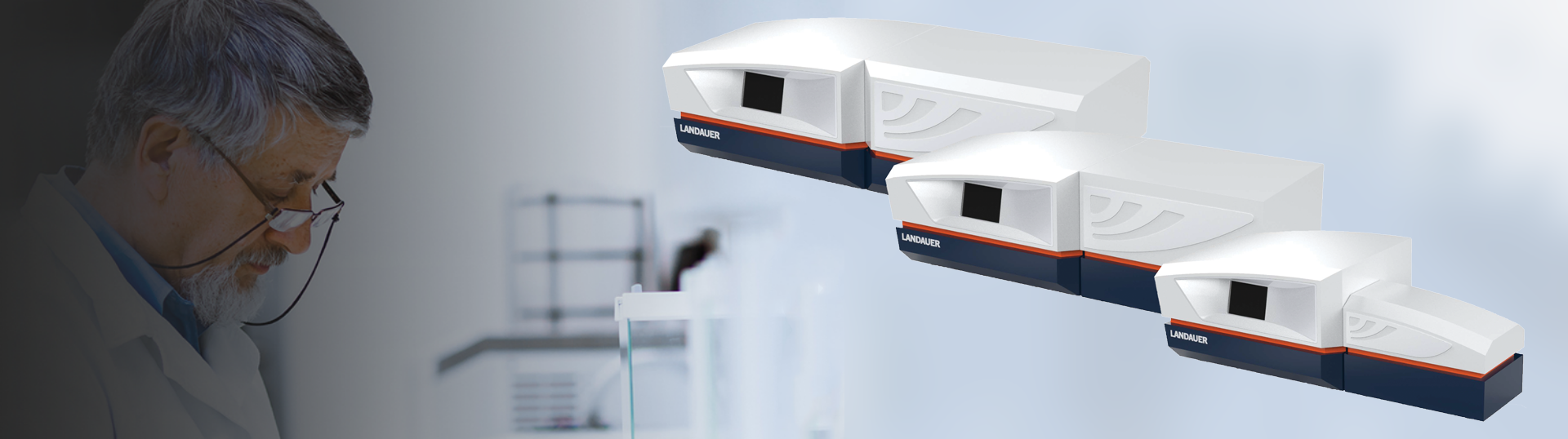
OSLR Reader Series for Radiation Measurements
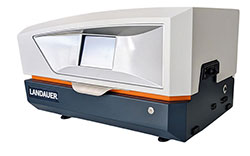
OSLR readers are designed for use with InLight™ dosimeters for whole body, environmental and emergency response monitoring.
All-in-one Dosimetry System
The OSLR Reader works with the LANDAUER InLight dosimeter, providing you with a complete solution for onsite dosimetry using LANDAUER OSL technology. OSLR Readers perform both reading and annealing process with very high throughput.
Quality, Simplicity, and Reliability
LANDAUER OSLR Readers include an external computer loaded with Integrated Research Application System (IRAS) software. The software automatically captures barcoded dosimeter serial numbers, which facilitates chain of custody. The reader and software provide control over setup, analysis, and database maintenance.
Quality Control (QC) procedures and data recording enable dosimeter readout, recording, and monitoring of reader performance. You receive rapid, accurate radiation assessments that can help improve the efficiency and productivity of your program.
High-quality components are used for durability and to ensure repetitive and long term performances. All important components are automatically and periodically checked with built in QC procedures.
Traditional techniques with internal radioactive sources or external irradiators are no longer required. OSLR Readers use QC delivered samples, internal LEDs, and photodiodes to perform all QC tests.
Scalability
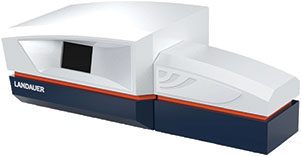
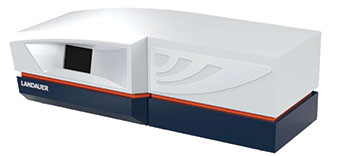
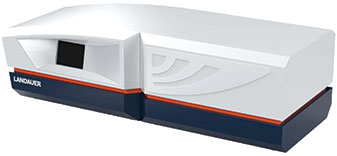
Select from four OLSR Readers to monitor the number of workers in your lab (1, 50, 250, 700). If your needs change, it's easy to upgrade the dosimeter capacity by changing to a larger loader. For small laboratories or emergency readouts, the OSLR1 is recommended.
OSL Technology
InLight dosimeters use our proprietary Al2O3:C Optically Stimulated Luminescence (OSL), which is used worldwide for radiation monitoring. The material
is manufactured by LANDAUER according to the highest standards and specifications.
OSL features and benefits:
- Fully Optical, No Heating: The readout process uses a light-emitting diode (LED) to stimulate the detectors, and the light emitted by the OSL material is detected and measured by a photomultiplier tube using a high-sensitivity photon counting system. The amount of light released during optical stimulation is directly proportional to the radiation dose and the intensity of stimulation light.
- Accreditation: Dose algorithms meet the requirements of the U.S. National Voluntary Laboratory Accreditation Program and U.S. Department of Energy Laboratory Accreditation Program
- No Calibration Required: The dosimeter sensitivity is determined during the manufacturing process by an ISO/IEC 17025 accredited laboratory. The sensitivity value engraved on the detector is automatically considered during the reading process.
- No Fading: InLight dosimeters make extended wear periods possible, with less than 5% fade in a year. The dosimeters can be reused for several years. The non-destructive readout process enables the dosimeters to be archived and re-read multiple times without corrections for fade.
OSLR Readers and InLight Dosimeters can be used for many applications:
- Occupational dosimetry
- Area monitoring
- Environmental monitoring
- On-site analysis
- Emergency response monitoring
InLight dosimeters monitor X, gamma, beta, and neutron radiation, and together with OSLR Readers, report Hp(10), Hp(0,07) and H*(10) dose.
Compliance with Standards
IEC 62387-1:2012 - We comply with passive integrating dosimetry systems for personal and environmental monitoring of photons and beta radiation for radiation protection instrumentation.
Many laboratories worldwide using LANDAUER dosimetry equipment are approved according to IS0/IEC 17025.
The LANDAUER laboratory is accredited by the National Voluntary Accreditation Program for ionizing radiation dosimetry, NVLAP LAB CODE 100518-0.

Key Features
- Read and anneal with one device! Read up to 300 dosimeters per hour and anneal up to 200 dosimeters per hour
- Simple and automatic calibration process ensures repeatability and accuracy
- Light-based reading process requires no gas supply for heating, creates no heat-induced artifacts or parameters, and requires less maintenance
- Reanalysis capabilities allows for multiple re-readings if necessary
- No fade enables longer wear frequencies
- Predetermined sensitivity levels engraved on barcode
- Remote diagnostic and maintenance abilities
- Compatible with Windows 11
|
|
OSLR1 | OSLR50 | OSLR250 | OSLR700 |
|
|
|
|
|
 |
| Model Type |
Benchtop |
|||
| Dosimeters/Hour |
N/A |
300 | 300 | 300 |
| Magazines/Dosimeters | 1/1 | 1/50 | Up to 5/250 | Up to 14/700 |
| Dimensions |
24.4×17.8×13.9 inches 620×452×352 mm |
39.8×17.8×13.9 inches 1011×452×352 mm |
43.3×17.8×13.9 inches 1100×452×352 mm |
46.7×17.8×13.9 inches 1186×452×352 mm |
| Weight |
79 lb/36 kg |
110 lb/50 kg | 162 lb/73 kg | 187 lb/85 kg |
| Power Requirements |
100-240 V, 1.5 A, 50-60 Hz |
|||
| Operating Temperature |
10 °C to 35 °C |
|||
| Storage Temperature |
-10 °C to 60 °C, 30-70% N.C. |
|||
| Protection Index |
IP40 |
|||
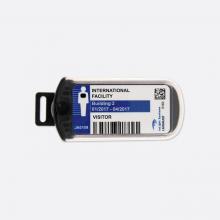
Radiation dosimetry badge with optically stimulated luminescence (OSL) technology for monitoring photon – X-ray, beta, gamma- and CR-39 for neutron detection radiation fields. InLight dosimeters are engineered to be read out by an InLight Reader. Designed for clients with extensive data management capabilities who prefer to independently maintain data and issue dose reports. Or opt for radiation monitoring services dose record keeping. For: Industrial, Emergency response, Research settings