What Should I Know?
- What is a radiological emergency?
| A radiological emergency is whenever a person or a group of people face a situation where they may be exposed to unexpected or uncontrolled hazardous levels of ionizing radiation. Emergencies create apprehension that can be managed by taking actions to know how much radiation dose one might or has received. Even actions taken to demonstrate no or minimal exposure can be just as important to allay fears and convey proper concern. The information below answers common questions for those who do not have much experience with radiation monitoring during emergencies. |
- What type of exposure should I be concerned about?
Exposure can arise from radiation sources found outside of the body (external radiation exposure) or from radioactive materials taken into the body after eating, drinking or breathing contaminated substances (internal radiation exposure). Both methods of exposure are important but the types of radiations of concern, the methods to measure radiation dose and the means to control and manage exposure are very different.
Radiation sources that emit x rays and gamma rays are the primary concern for external radiation exposures because the range of these radiations is great; they are able to penetrate the body and expose the internal organs; and their intensity can be so great as to cause acute radiation sickness. Lower doses that do not cause acute sickness may still present an increased risk of developing cancer years after exposure. Fortunately, doses from x and gamma rays are easy to measure with simple, inexpensive radiation monitoring badges. Monitoring external radiations is one of the first actions taken in an emergency.
Radioactive contamination of the skin can cause local areas of high dose but more frequently and importantly indicates a danger of radioactive materials finding their way into the body. Contamination monitoring is accomplished with moderately expensive survey instruments and is best performed by a person trained in radiation measurements.
Exposures to radioactive materials residing in the body can be much more difficult to assess and are potentially more serious. Detection requires special instruments to locate and identify the types of radiations present. Unfortunately it is impossible to directly measure the internal doses so doses are estimated from assessments of the quantity of radioactive located in critical organs. Internally deposited radioactive materials can be concentrated in various organs and be retained for long periods of time. Such chronic types of exposures may increase the chance to develop cancer in later years should the dose accumulate high enough.
|
- What radiation effects should I be aware of?
Radiation safety experts express radiation dose in terms of milliSeivert (mSv) or microSeivert (µSv). One mSv is equal to 1,000 µSv. In 2009, the National Commission on Radiation Protection and Measurements (NCRP) reported that the average dose from naturally occurring radiation to a person living in the United States was slightly more than 3 mSv per year or about 8 µSv per day. People living at high elevations or in areas of increased radon will receive higher than average doses. A person receives an almost equal amount from medical uses of radiation in the diagnosis and treatment of diseases.
The health effects resulting from radiation exposure may not appear for days, weeks or even years. In general, health effects of radiation can be categorized into short-term effects from high doses (in excess of 200 mSv) received over short periods and long-term effects from continuous or prolonged exposure to low levels of radiation which could result in an elevated lifetime risk of cancer induction.
|
- How can I determine how much radiation one has been exposed to?
Radiation monitoring badges or personnel radiation dosimeters are most frequently used to measure the amount of external radiation dose to an individual. These badges can also be used to determine the radiation dose in an area. Personnel dosimeters accumulate the total radiation dose to which they were exposed. They are simple to use, light weight, extremely rugged and inexpensive. They are clipped to a shirt, blouse or coat like an identification badge.
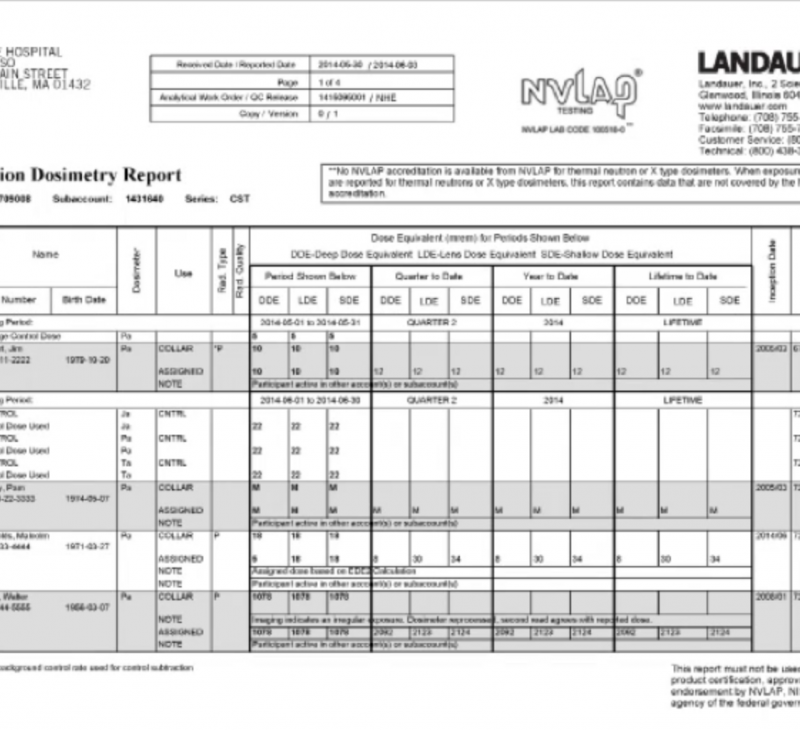
Generally, a badge is given to a single individual for use during the emergency period. This is called a one time use dosimeter. After the emergency, the badge is returned to LANDAUER where it is processed, the data reported and archived should there be any post-event inquiries. LANDAUER does not recommend using its badges for periods longer than one year. If significant doses are expected, exchange dosimeters on a monthly or quarterly basis.
For radiological emergencies, LANDAUER will provide the InLight Model 2 badge.

For additional information about personnel or area monitoring services provided by LANDAUER, or to order new service, contact LANDAUER at 1-800-561-2708 or email inlightcustserv@landauer.com.
LANDAUER dosimeters are not appropriate to measure doses from internal exposure, or from contamination of food or water.
|
- What do I need to know when starting a monitoring program?
First, identify who and where radiation exposure or concern exists. It is most important to identify groups of people and their probability for exposure. Anyone who may enter an area whose access is limited for radiation safety precautions (exclusion area) should certainly be monitored. It is also advisable to monitor those who may spend time near exclusion zones. At large distances from the exclusion area, a combination of area monitoring and selected individual monitoring may be warranted, particularly if you are trying to limit total doses to less than 1mSv, the recommended limit for exposure of the general public from nuclear activities.
An important component of monitoring is keeping a record of who was monitored, when and the dose result. Each LANDAUER dosimeter is labeled with a unique participant number that can be linked to a name. If you know who specifically who will get a dosimeter, provide the names to LANDAUER and the names can be printed on the badges. For many, it is usual not to know who will get a dosimeter, so keep a distribution log and later provide LANDAUER the names and we will link the user’s name to the badge number to establish a complete record. The packing list that comes with the badges can make a good distribution log.
|
- How soon can I get monitoring badges?
LANDAUER can prepare the dosimeters generally within 12 hours of receiving an order and ship using over-night carriers like FedEx or if necessary by a courier. LANDAUER routinely ships all over the world and has branch offices in Australia, Brazil, China, France, Japan, Mexico, Sweden, Turkey and the United Kingdom that are all prepared to assist in the event of an emergency.
If you will be traveling with dosimeters, do not place dosimeters into checked luggage. Instead, carry them onto the airplane with you. Radiation from CT scanners that are used to screen checked luggage will be detected by the dosimeters.
|
- How soon can I get dosimeter results?
Emergency dosimeters returned to LANDAUER are immediately processed and a formal report prepared within 24 hours. Expedited phone, email or fax notification is made should unusually high doses be observed. Reports comply with NRC (Nuclear Regulatory Commission), OSHA (Occupational Safety and Health Administration) and DOE (Department of Energy) regulations. All emergency dose results are obtained under the National Voluntary Laboratory Accreditation Program accreditation issue to LANDAUER by the National Institute of Standards and Technology, US Department of Commerce.

|
- One more thing: Control Dosimeters
| One or more special dosimeters called “control dosimeter” are included with each shipment to monitor radiation that may occur during transit or storage when the badges are not in use. When returning used badges, the control dosimeter should accompany those badges that were shipped with it for the most accurate results for very low doses. If the control is lost or a control dosimeter is not available go ahead and return the used dosimeters. Do not use the control dosimeter for any other purpose. Store control dosimeters away from radiation when not in use (do not store dosimeters near a radioactive source). |
- A message for First Responders
LANDAUER provides a complete dosimetry kit with InLight® badges and the micorStar® reader designed to allow one to analyze and record dosimetry information without having to return dosimeters to LANDAUER. This avoids any delays in getting dose information to manage response activities. Please contact LANDAUER for more information about this and other products for emergency monitoring of radiation exposure.
For additional information about LANDAUER’s complete dosimetry solutions for first responders, click here or contact LANDAUER at 1-800-561-2708 or email inlightcustserv@landauer.com.
|
|
Letter from Bill Saxelby, CEO of LANDAUER, Inc.
Additional Crisis Information
|